Assembly 2024: Palestine as Symptom and Cause

Beirut Institute for Critical Analysis and Research
Assembly 2024: Palestine as Symptom and Cause
June 18–22, 2024, Online + Beirut

معهد بيروت للتحليل النقدي والبحوث
تجمع ٢٠٢٤: فلسطين العارض والسبب
١٨-٢٢ حزيران، ٢٠٢٤، عبر الانترنت + في بيروت

  1. English
    1. Critical Theory During Genocide
    2. Streams 
    3. Assembly Program
      1. Day 1: Tuesday, 18 June, 2024 12pm – 8pm Beirut time, online + on site
      2. Day 2: Wednesday, 19 June, 2024 12pm – 8pm Beirut time, online + on site
      3. Day 3: Friday, 21 June, 2024 3pm – 10pm Beirut time, online + on site
      4. Day 4: Saturday, 22 June, 2024 8pm – 10pm Beirut time, online + on site
    4. Registration
  2. العربية
    1. النظرية النقدية أثناء الإبادة الجماعية
    2. المسارات
    3. برنامج التجمع
    4. للتسجيل

English

Critical Theory During Genocide

This year BICAR will host a hybrid assembly for Palestine; both online and on site in Beirut. Configured as a series of public talks and discussions, this year’s Palestine assembly will include scholars and thinkers joining us both online and, as much as circumstances permit, in person.

Israel’s genocidal military campaign against Palestine and Gaza in particular makes business as usual impossible for Critical Theory. There is no neutral ground in this historical conjuncture, whether in academia, culture, or politics. The program of this year’s BICAR assembly is a response to the silence and complicity from scholars and institutions in the fields of Critical Theory and psychoanalysis. This cultural and scholarly complicity and its disavowed reality are symptomatic. The question of Palestine exposes the cracks in the Western capitalist world order and its supporting ideologies, including the constituent hypocrisy of Human Rights Discourse, its exceptions and beneficiaries.

The event that occurred on October 7, 2023, happened at a time when Israel, the US and their allies thought they had moved beyond both the question and the symptom of Palestine, relegating the Palestinian cause to the necropolitical management of contained space under Israeli sovereignty. This attempt at ‘conflict management’ failed and its cultural and humanitarian support collapsed along with it. Having committed an unprecedented massacre against the population of Gaza, Israel has now created a reality of genocide that rules out any return to the status quo ante.

At this point of no return, the history of the Palestinian cause and its struggles must be recalled. The Palestinian cause was central to the Arab left and the Marxist politics of the twentieth century because ‘Palestine’ was not a reified identity but the name for a universalist struggle that was at once anti-colonial and anti-capitalist. ‘Palestine’ was a unifying signifier for the struggle against reactionary politics, against fascists and identitarians; a thorn in the side of the bourgeois Arab nationalists and liberals alike. What is the legacy of this struggle for contemporary Marxism, Critical Theory and psychoanalysis? The Palestine question is the present and historically persistent form that allows us to see the intersections of these fields and what they may offer to emancipatory politics.

This call is addressed to local and international participants. Due to the imminent threat of escalating Israeli attacks on Lebanon, we refrain from inviting participants to Lebanon to attend in person. Local participants and those from the region may choose to attend the in-person seminars and talks in Beirut. The same applies for our invited guests. Thus, there will be offline and/or hybrid events on site in Beirut during the week of June 18-22, 2024. Please let us know in advance if you intend to join on site in Beirut. In light of the situation, we ask international participants intending to come to Beirut to make their travel plans as late as possible.

Streams 

We do not intend to run this assembly as a business-as-usual academic event. BICAR is proposing three streams for the assembly as well as additional invited guests.

There will also be invited speakers outside these streams that will speak to the question of Palestine as these relate to land, law, struggle, resistance, mourning, and beyond.

BICAR streams during the assembly:

  • Stream 1: The Psychoanalysis of Genocide
    hosted by Nadia Bou Ali

What could be a psychoanalysis of genocide? Genocides repeat, they are however singular in their structure:  often accompanied by fascist politics that affirm life by denying the death of ancestors, and the undeadness of the fatherland. Will-power becomes force and the extermination of anything in the way of this form of life becomes the only path forward. Genocide has an implicit teleology: it is very clear in its aims from the start, the form of extermination only varies. More often than not, genocides are accompanied by witnesses and bystanders who practice complex mechanisms of disavowal and displacements. These ‘innocent bystanders’ , the two-siders, the just-war theorists, the university discourse at work in churning out justification, enable the continuation of genocide whose only victims are in turn identified as ‘innocent’ collateral. Those who fight, who resist, have no history in the time of genocide. In the future, when the genocide surfaces into the narratives of history proper, the innocents will be identified only as  non political actors. The sinister under-side of genocide is that it strips those it seeks to exterminate, and especially those who resist, from their subjectivity: they are not subjects but victims, at best, in retrospect. The psychical labor involved in this procedure is arguably what allows for the repetition of genocide in different places albeit in the same form. How to analyse this structure of perverse disavowal that inflicts bystanders and witnesses? How to undo the ritualistic knot of the killing machine as it blindly re-sacralizes life and offers sacrifices for its undead ancestors? How to work through the ongoing ugly enjoyment, that if not stopped, promises to continue and to repeat elsewhere. A psychoanalysis of genocide seeks to extricate the universality of the struggle of the Palestinian people, in their fight against a machine of death that is a dead machine whose spirit is the undead ancestor.


  • Stream 2: Palestine as Symptom: Critique of Human Rights Discourse
    hosted by Sami Khatib and Ghalya Saadawi

Explaining the mismatch of Israel’s human rights abuses against Palestinians and neighboring populations, and Israel’s self-image as a victim-state engaging in so-called self-defense, Robert Meister drew the following conclusion: “In post-Holocaust debates about human rights, the violence that Israel uses to defend itself has become a laboratory for the violence that the ‘world community’ (especially the U.S.) would be obliged to use in protecting an Israel that could not defend itself. The post-Holocaust security of Israel thus stands as the constitutive exception on which twenty-first-century humanitarianism is based.” (2011). Relying on Meister’s critique of the Western human rights discourse, alongside other critiques of the morals underpinning human rights and the capitalist economy more broadly, as well as the both memorial and counter-revolutionary function of these, this stream focuses on Palestine as a symptom. By resisting Israel’s occupation and refusing to be reconciled victims, the enduring struggle of Palestine also resists a world order that has deemed the struggle for justice part of an “evil past” in a world of postponed justice. The Palestinian cause thereby exposes the moral underbelly of  Realpolitik in which beneficiaries can enjoy their gains in an “ethical” way by reaching out to depoliticized victims, whilst persecuting those engaged in freedom struggles as unreconciled victims of a global order.


  • Stream 3: The Question of Anti-Semitism as Deflection, Anti-Semitism as Conspiracy Theory
    hosted by Ray Brassier

The identification of anti-Zionism with anti-Semitism has become the principal weapon used against advocates of Palestinian liberation. This identification has a long history, at once political and theoretical. Among its primary theoretical inspirations is the work of Moishe Postone, which also provides its veneer of academic credibility. Rejecting the explanatory links between fascism, colonialism, and genocide, Postone sidelines the historical specificity of the Holocaust to emphasize its historical singularity as inextricable from that of Nazism. Like Nazism, the Jewish Holocaust is historically unique and incomparable. The historical singularity of the Holocaust is the Jewish state’s raison d’etre; Israel’s existence is the historical ratification of anti-anti-Semitism. According to Postone, anti-Zionism conflates anti-Semitism with racism and the Jewish state with an ethno-nationalist settler colony. In so doing, it mistakes anti-colonial resistance for resistance to capital. Moreover, by pitting concrete resistance against abstract domination and native against settler, anti-Zionism unwittingly repeats the fetishization of the concrete characteristic of modern (i.e. Nazi) anti-Semitism. Postone’s arguments have gained traction among certain segments of the Left, who invoke them not only to discredit advocacy for the Palestinian resistance but also to drive a wedge between anti-colonialism and anti-capitalism more generally. While Postone’s claims rely on a number of equivocations that can be easily dismantled, what is more difficult but equally necessary at this juncture is to identify the combination of historical and political factors that have rendered them persuasive for many on the Left, despite their dubious conceptual cogency.


Assembly Program

Day 1: Tuesday, 18 June, 2024
12pm – 8pm Beirut time, online + on site

Opening remarks

Psychoanalysis of Genocide 1
Abboud Hamayel

Jamil Khader
Žižek’s Response to the Gaza Genocide: The Ends of Pragmatic Realism

Nihal El Aasar
Left-wing Melancholia? The de-politicization/re-politicization of Arab masses.


Psychoanalysis of Genocide 2
Hannah Zeavin
Breakdown of a Fear

Sophie Mendehlson

Robert Beshara
Seeing Gazans Through Decolonial Eyes: History as the Future

Gabriel Tupinambá


Psychoanalysis of Genocide keynote
Françoise Vergès

12:00pm

12:30pm


4:30pm


7:00pm

Day 2: Wednesday, 19 June, 2024
12pm – 8pm Beirut time, online + on site

Critique of Human Rights Discourse keynote
Jessica Whyte
Gaza and the End of Humanity

General Stream
Hazem Jamjoum
Kanafani after Aylul, and the Statehood Schism

Harry Halpin
AI and Extermination: Philosophy after Gaza


The Question of Anti-Semitism as Deflection, Anti-Semitism as Conspiracy Theory
Daniel Tutt
Elements of Islamophobia: Imperialism, Decadence and the Lifting of Taboos

Sai Englert
From the Abstract to the Concrete (and Back Again?): Antisemitism and the Rise of Fascism

Barnaby Raine
Race and Reflexivity: Some Elisions in Moishe Postone’s Theory of Anti-Semitism

General Stream keynote
Jodi Dean
Palestine Speaks for Everyone

12:00pm


1:30pm


3:30pm


7:00pm

Day 3: Friday, 21 June, 2024
3pm – 10pm Beirut time, online + on site

Critique of Human Rights Discourse 1
Nader Andrawos
In the Shadow of Genocide in Gaza

Adam HajYahia
The Principle of Return

Critique of Human Rights Discourse 2
Dirk Moses
Palestine and the Problems of Genocide

Alberto Toscano
Zionism Breaks, or, In Praise of Divisive Concepts

Brenna Bhandar
International law and colonial capitalist land theft in Palestine

Resistance Poetry (ar + en)
Bassem Saad
Mohamad Nassereddine

3:00pm


5:00pm


8:00pm

Day 4: Saturday, 22 June, 2024
8pm – 10pm Beirut time, online + on site

Critique of Human Rights Discourse keynote
Robert Meister
Pre-atonement

Closing remarks

8:00pm


Registration

**Online attendance is at capacity.**

Participants are asked to contribute with a donation of $50 or more to the Ghassan Abu Sittah Children’s Fund.

To attend in person, please email info@bicarlebanon.org.


العربية

النظرية النقدية أثناء الإبادة الجماعية

يستضيف بيكار(معهد بيروت للتحليل النقدي والبحوث) هذا العام تجمعًا لأجل فلسطين، يتخذ حيزه عبر الإنترنت وفي بيروت. سيضم هذا التجمع الذي تم تشكيله كسلسلة من المحادثات والمناقشات العامة، علماء ومفكرين ومفكرات ينضمون إلينا عبر الإنترنت، وحضوريًّا، بقدر ما تسمح الظروف

في ظل الحملة العسكرية الإسرائيلية للإبادة الجماعية ضد فلسطين عامّةً، وغزة على وجه الخصوص، يُصبح العمل بشكل مُعتاد بالنسبة للنظرية النقدية، مستحيلًا. لا يوجد موقف محايد في هذا الظرف التاريخي، سواء في المجال الأكاديمي أم الثقافي أم السياسي. يأتي برنامج تجمع بيكار لهذا العام بمثابة ردّ على صمت وتواطؤ الأكاديميين والمؤسسات في مجالي النظرية النقدية والتحليل النفسي. إن هذا التواطؤ الثقافي والعلمي وحقيقته المُنكرة هو تواطؤ عارضي. تكشف قضية فلسطين عن الثغرات في النظام العالمي الرأسمالي الغربي والأيديولوجيات الداعمة له، بما في ذلك النفاق التأسيسي لخطاب حقوق الإنسان واستثناءاته والمستفيدين منه 

جاءت أحداث السابع من أكتوبر 2023 في وقت اعتقدت فيه إسرائيل والولايات المتحدة وحلفاؤهما تجاوزهم لفلسطين وعوارضها، إذ كانوا قد أحالوا القضية الفلسطينية وحصروها في إدارة سياسات الموت المندرجة تحت السيادة الإسرائيلية. فشلت هذه المحاولة في “إدارة الصراع” وانهار دعمها الثقافي والإنساني معها. خلقت إسرائيل بعد أن ارتكبت مذبحة لم يسبق لها مثيل ضد سكان غزة، واقعًا من الإبادة الجماعية يُستبعد إثره أي عودة إلى الوضع السابق

وعليه، لا بدّ عند نقطة اللاعودة هذه، من التذكير بتاريخ القضية الفلسطينية ونضالاتها. كانت القضية الفلسطينية محورية بالنسبة لليسار العربي والسياسة الماركسية في القرن العشرين لأن “فلسطين” لم تكن هوية راسخة، بل شكلت اسمًا لنضال عالمي كان في الوقت نفسه مناهضًا للاستعمار والرأسمالية. كانت “فلسطين” رمزًا موحدًا للنضال ضد السياسة الرجعية، وضد الفاشيين والهَوِياتيين. وكانت، كذلك، شوكةً في خاصرة القوميين والليبراليين العرب البرجوازيين على حد سواء.  ما هو إرث هذا النضال من أجل الماركسية المعاصرة والنظرية النقدية والتحليل النفسي؟  تمثل قضية فلسطين الشكل الحالي والتاريخي المستمر الذي يسمح لنا برؤية تقاطعات هذه المجالات وما يمكن أن تقدمه للسياسة التحررية

هذه الدعوة موجهة إلى المشاركين المحليين والدوليين. لكننا نمتنع عن دعوة المشاركين للحضور شخصيًا إلى لبنان، نظرًا للتهديد الوشيك بتصعيد الهجمات الإسرائيلية على البلد. يمكن للمشاركين المحليين والمشاركين من المنطقة اختيار حضور الندوات والمحاضرات شخصيًّا في بيروت. ينطبق الشيء نفسه على ضيوفنا المدعوين. وبالتالي، ستعقد فعاليات غير متصلة بالإنترنت و/أو مختلطة في موقع بيكار في بيروت خلال الأسبوع الممتد بين 18 يونيو/حزيران  2024  حتى 22 يونيو/ حزيران 2024

نرجو إعلامنا مسبقًا في حال كنتم تعتزمون الانضمام إلى موقع الفعالية في بيروت. بناءً على الوضع الراهن، نطلب من المشاركين الدوليين الذين يعتزمون القدوم إلى بيروت تأخير ترتيبات سفرهم قدر الإمكان

المسارات

لا ننوي إدارة هذا التجمع كحدث أكاديمي اعتيادي. يقترح بيكار ثلاثة مسارات للتجمع، إضافةً إلى ضيوف مدعوين.

سيضم المؤتمر أيضًا متحدثين مدعوين من خارج هذه المسارات، حيث سيتناولون قضية فلسطين فيما يتعلق بالأرض والقانون والنضال والمقاومة والحداد وما هو أبعد

المسار الأول: التحليل النفسي للإبادة الجماعية
تقدم المسار نادية بوعلي

ماذا يمكن أن يكون التحليل النفسي للإبادة الجماعية؟ تتكرر عمليات الإبادة الجماعية، ولكنها تبقى، رغم ذلك
فريدة في هيكلها، إذ غالبًا ما تكون مصحوبة بسياسات فاشيّة تؤكد الحياة من خلال إنكار موت الأجداد، وعدم
موت الوطن الأم. تتحول قوة الإرادة إلى قوة دافعة، وتصبح إبادة أي شيء، في طريق هذا الشكل من الحياة،
السبيل الوحيد للمضي قدمًا. للإبادة الجماعية غايتها الضمنيّة، فهي واضحة جدًا في أهدافها منذ البداية، وما
يختلف هو شكل الإبادة فقط. تكون الإبادة الجماعية في أكثر الأحيان، مصحوبة بشهود ومتفرجين يمارسون
آليات معقدة للتنصل والتشريد. يسهّل هؤلاء “المتفرجون الأبرياء”، داعمو الطرفان/ المحايدون، منظرو الحرب
العادلة، وصانعو الخطاب الجامعي في العمل على إنتاج الرواية القضائية، استمرار الإبادة الجماعية التي يتم
تحديد ضحاياها الوحيدين بدورهم على أنهم ضمانات “بريئة”. لا يملك أولئك الذين يقاتلون، والذين يقاومون،
تاريخًا في زمن الإبادة الجماعية، وفي المستقبل، عندما تُذكر الإبادة الجماعية في سرد التاريخ نفسه، لن يتم
تعريف الأبرياء إلا كجهات فاعلة غير سياسية. إن الجانب الشرير من الإبادة الجماعية هو أنها تجرد أولئك الذين
تسعى إلى إبادتهم، وخاصة أولئك الذين يقاومون، من ذاتيتهم: فهم لن يظهروا، بالعودة إلى الماضي، كرعايا بل
كضحايا، في أحسن الأحوال. ويمكن القول إن العمل النفسي الذي ينطوي عليه هذا الإجراء هو ما يسمح بتكرار
الإبادة الجماعية في أماكن مختلفة وإن كان بالطريقة ذاتها. كيف نحلل هذا التنصل المنحرف والإنكار المسيطر
على المارة والشهود؟ كيف يمكن التراجع عن عقدة شعائر وطقوس آلة القتل لأنها تعيد بشكل أعمى تقديس الحياة
وتقدم تضحيات لأسلافها الموتى الأحياء؟ وما هي كيفيات العمل من خلال المتعة القبيحة المستمرة، والتي إذا لم
تتوقف، تنذر بالاستمرار والتكرار في مكان آخر.. يسعى التحليل النفسي للإبادة الجماعية إلى تخليص عالمية
نضال الشعب الفلسطيني، في كفاحه ضد آلة الموت التي هي آلة ميتة وروحها هي السلف الميت


المسار الثاني: فلسطين كعارض: نقد خطاب حقوق الإنسان
يقدم المسار كل من سامي خطيب وغالية سعداوي

استخلص روبرت مايستر، في معرض تفسيره لعدم تطابق انتهاكات إسرائيل لحقوق الإنسان بحق الفلسطينيين
والسكان المجاورين، وصورة إسرائيل الذاتية كدولة ضحية تمارس ما يسمى الدفاع عن النفس، الاستنتاج التالي: في المناقشات حول حقوق الإنسان في مرحلة ما بعد الهولوكوست، أصبح العنف الذي تستخدمه إسرائيل للدفاع
عن نفسها مختبرًا للعنف الذي سيضطر المجتمع الدولي (وخاصة الولايات المتحدة) إلى استخدامه في حماية
إسرائيل التي لا تستطيع الدفاع عن نفسها. وبالتالي، فإن أمن إسرائيل بعد الهولوكوست هو الاستثناء التأسيسي
الذي تقوم عليه النزعة الإنسانية في القرن الحادي والعشرين. (2011). بالاعتماد على نقد مايستر للخطاب
الغربي لحقوق الإنسان، إلى جانب انتقادات أخرى للأخلاق التي تقوم عليها حقوق الإنسان والاقتصاد الرأسمالي
على نطاق أوسع، فضلًا عن الوظيفة التذكارية والمناهضة للثورة، يركز هذا العرض على فلسطين كأحد
الأعراض. يُعد كفاح الفلسطينيين الدائم، بمقاومتهم للاحتلال الإسرائيلي ورفضهم أن يكونوا ضحايا مُصالَحين،
سبيلًا إضافيًا لمقاومة نظام عالمي يعتبر الكفاح من أجل العدالة جزءًا من “ماضي شرير” في عالم تأجلت فيه
العدالة، وبالتالي، فإن القضية الفلسطينية تكشف عن الجوهر الأخلاقي للسياسة الواقعية التي يمكن للمستفيدين من
خلالها التمتع بمكاسبهم بطريقة “أخلاقية” من خلال الوصول إلى الضحايا غير الُمسيّسين، في حين يُضطهد
أولئك المنخرطين في النضال من أجل الحرية كضحايا للنظام عالمي، ضحايا لا يخضعون للتسويات


المسار الثالث: مسألة معاداة السامية كانحراف، معاداة السامية كنظرية مؤامرة
يقدم المسار راي براسير

لقد أصبح ربط معاداة الصهيونية بمعاداة السامية السلاح الرئيسي المستخدم ضد دعاة التحرير الفلسطيني. لهذه
الهوية تاريخ طويل، سياسي ونظري في الوقت ذاته. ومن أهم مصادر إلهامها النظرية، أعمال موشيه بوستون
التي تُضفي عليها أيضًا مظهرًا من المصداقية الأكاديمية. يُبعد بوستون، برفض الروابط التفسيرية بين الفاشية
والاستعمار والإبادة الجماعية، التحديد التاريخي للهولوكوست ليؤكد على فرديته التاريخية باعتبارها لا تنفصل
عن النازية. ومثلها مثل النازية، فالمحرقة اليهودية فريدة من نوعها تاريخيًّا ولا تضاهى. إن الفرادة التاريخية
للهولوكوست هي السبب الأساسي لوجود الدولة اليهودية؛ فوجود إسرائيل هو التصديق التاريخي لمناهضة معاداة
السامية. وفقًا لبوستون، فإن معارضة الصهيونية تخلط بين معاداة السامية والعنصرية والدولة اليهودية وبين
مستعمرة استيطانية عرقية قومية. وهي بذلك تُخطئ المقاومة المناهضة للاستعمار بمقاومة رأس المال. علاوة
على ذلك، من خلال التركيز على مواجهة المقاومة الملموسة مع الهيمنة المجردة، ومواجهة السكان الأصليين مع
المستوطنين، تعكس معارضة الصهيونية نفس خاصية التفتيش الملموسة التي تميز معاداة السامية الحديثة
(النازية). وبالتالي ، فإنه يكرر عن غير قصد هذه السمة المكونة لمعاداة السامية الحديثة. لقيت حجج بوستون
قبولاً بين بعض شرائح اليسار، وبين من يستخدمونها ليس من أجل إضعاف الدفاع عن المقاومة الفلسطينية
وحسب، ولكن أيضًا لإيجاد هوة بين مناهضة الاستعمار ومناهضة الرأسمالية بشكل عام. على الرغم من أن
مزاعم بوستون تعتمد على عددٍ من المراوغات التي يمكن تفكيكها بسهولة، فإن الأمر الأكثر صعوبة ولكنه
ضروري بنفس القدر في هذه المرحلة هو تحديد مجموعة العوامل التاريخية والسياسية التي جعلتها مقنعة للكثير
من شرائح اليسار، على الرغم من ضعف حججها المفاهيمية


برنامج التجمع

.سيتم الإعلان عن البرنامج المفصل للتجمع قريبًا

اليوم الأول: الثلاثاء ١٨ يونيو ٢٠٢٤
١٢ ظهراً – ٨ مساءً بتوقيت بيروت، عبر الانترنت + حضوريًّا

اليوم الثاني: الأربعاء ١٩ يونيو ٢٠٢٤
١٢ ظهراً – ٨ مساءً بتوقيت بيروت، عبر الانترنت + حضوريًّا

اليوم الثالث: الجمعة ٢١ يونيو ٢٠٢٤
٣ ظهراً – ١٠ مساءً بتوقيت بيروت، عبر الانترنت + حضوريًّا

اليوم الرابع: السبت ٢٢ يونيو ٢٠٢٤
٨ مساءً – ١٠ مساءً بتوقيت بيروت، عبر الانترنت + حضوريًّا

للتسجيل

.يطلب من المشاركين المساهمة بالتبرع بمبلغ ٥٠ دولارًا أو أكثر لـ صندوق غسان أبو ستة للأطفال

.info@bicarlebanon.org :للحضور شخصياً الرجاء التواصل عبر البريد الاكتروني

About BICAR

Established in 2015, the Beirut Institute for Critical Analysis and Research (BICAR) aims to promote critical thought and analysis with a special focus on studying manifestations of modernity in Lebanon and the Middle East. As a public research and educational institute, BICAR seeks to cultivate a space for rigorous research, debate, and dialogue. It intends to foster cultures of critique capable of understanding Lebanese modernity in relation to processes of modernization that are part of a global dynamic. BICAR has two fundamental commitments: to disseminate pedagogical and research oriented projects in Arabic and English to a wide audience in Beirut, Lebanon, and beyond; and to foster the relationship between intellectual inquiry, social reality, and social change. BICAR’s founding members are Dr. Nadia Bou Ali, Dr. Ray Brassier, Mr. Rohit Goel, Dr. Angela Harutyunyan, Dr. Sami Khatib, and Dr. Ghalya Saadawi.

BICAR Assembly 2024 is supported by Barzakh.
BICAR Summer School 2023

Beirut Institute for Critical Analysis and Research 
Summer School June 2023
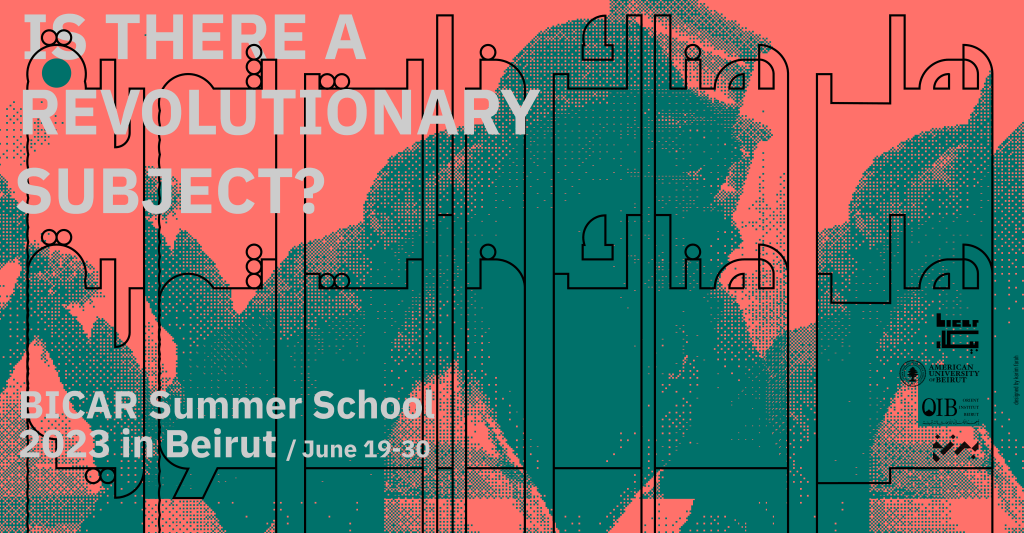
June 19-30, Beirut
Is There a Revolutionary Subject?

Is the absence of revolution due to the absence of a revolutionary subject? Or to the belief that revolution requires a subject? The critique of the subject–Cartesian, Kantian, Hegelian– is the cornerstone of the Nietzschean and Heideggerian critiques of modernity (and of their reactionary politics). It was subsequently given an emancipatory cast not only by Nietzschean thinkers such as Derrida, Foucault, and Deleuze but also by Marxists like Adorno, for whom the primacy of the subject forms the crux of the logic of domination. From this vantage, Lukacs’ theory of the revolutionary subject, which centers the proletariat as self-conscious commodity, is supposedly tainted not just by residual Hegelianism but by a logic of domination culminating in Stalinism. Yet perhaps the time has come to re-appraise Lukacs’ theory, given that no alternative of comparable power has come to replace it.

Psychoanalysis, for its part, develops a more nuanced critique of the subject. Where poststructuralism reduces the subject to an effect of impersonal forces–substantializing the unconscious–psychoanalysis conceives it as an irreparable tear in the fabric of being. The subject is the gap manifesting the unconscious as ‘not-fully-being’. In this regard, psychoanalysis renovates the Hegelian concept of the subject as self-relating negativity. Subjective destitution, as conceived by Lacan, is only possible via the discourse of psychoanalysis, which paves the way for a transformative act. But the destitution of the subject in contemporary critical discourse continues to be conceived in poststructuralist terms. This destitution marks the shift from the conception of revolution as total explosion to the claim that what is revolutionary is the explosion (or implosion) of totality. Disintegration and fragmentation become the new indices of social subversion. The political valence of this shift has been much debated: subversion of liberalism or liberal subversion? Both remain politically equivocal: the disintegration of totality is affirmed by fascist reactionaries as well as utopian anarchists.

History also seems to confirm the destitution of the revolutionary subject. The European working class’s post-war accommodation with capitalism (not to mention its embrace of fascism in the 1930s) casts doubt on attempts to invest it with revolutionary agency. In the fifty years since the end of the post-war boom (1973), capital’s renewed onslaught against labor has not reconsolidated the working class into a revolutionary subject. Thus communists have reaffirmed the distinction between proletariat and working class to challenge the latter’s revolutionary credentials together with the assumption that revolution requires a unitary subject. This includes not only Althusserians, for whom history is a process without a subject, but also those who propose that self-negation, rather than self-affirmation, is the motor of proletarian struggle against capital. In a related but distinct vein, Alain Badiou makes the theory of the subject central to communism while decoupling revolutionary subjectivation from the appropriation of production. Lastly, Adorno’s critique of the principle of subjectivity seeks to preserve the singularity of individual experience as a site of resistance to capitalist totality. The question is whether such singularity can be encompassed by class struggle and reconnected to collective solidarity. In all these instances, the concepts of capital, labor, totality, revolution, and subject are variously articulated with very different political consequences.

Moreover, how do the objective and subjective dimensions of race, gender, and sexuality connect with those of class? If proletarianization is an ongoing process that consists of homogenizing and commodifying subjective experience, what are the concrete mechanisms through which it occurs? The list might include capitalist ecologies, the privatization and individualization of symptoms by the therapy and wellness industries, as well as the ongoing co-optation of all potential sites of radical enunciation by the discourses of neo-liberal capitalism. How might a revolutionary subject withstand this slow emptying out of social experience? Can it be sustained against such mechanisms? What kind of militancy is required and what can psychoanalysis actually offer to militant subjects in this regard? Can psychoanalysis help resist this process of psychic hollowing? Could it help reconstruct a theory of the revolutionary subject?

This summer school will investigate the different registers and political valences of the critique of the subject and try to gauge its consequences for the understanding of revolution. Is the destitution of the subject revolutionary? Or does it ultimately dissolve revolution as idea and political practice?


Course I – Dr. Nadia Bou Ali
Subjective Destitution

Psychoanalysis has one main promise for politics and it is surely not a joyful one: the experience of subjective destitution is one possible way to counter the generalized systemic enjoyment that prevails in late capitalism. What is subjective destitution really? How can it be explained if it is not experienced? The seminar will discuss this in the context of Lacan’s theory of four discourses (Seminar XVII) and ask is the discourse of the analyst a discourse of subjective destitution? If so, what is the actual use of this politically?

Dr. Nadia Bou Ali is Associate Professor and Chair of the Civilization Sequence Program at the American University of Beirut. She is the author of Hall of Mirrors: Psychoanalysis and the Love of Arabic (Edinburgh University Press 2020).


Course II – Dr. Ray Brassier
Theories of the Communist Subject

This course will consider whether the critique of Marxist programmatism and the perspective of communisation developed by Theorie Communiste (TC) dissolves or renews the question of the revolutionary subject. We will examine the theoretical presuppositions and political implications of the fundamental question guiding all of TC’s analyses, namely: “How can the proletariat, acting strictly as a class, be the class that abolishes class?” We will compare TC’s analysis to that of theorists who offer positive accounts of the communist subject, such as Lukacs and Badiou, as well as to theorists who consign the category of the subject to capital, such as Postone.

Dr. Ray Brassier is Professor of Philosophy at the American University of Beirut. He is the author of Nihil Unbound: Enlightenment and Extinction (Palgrave 2007).


Course III – Dr. Sami Khatib
The Specter of Universalism: Concepts, Politics, Ideologies

This course starts from Vivek Chibber’s insight that in global capitalism at least two universalisms are at work: (1) the “universalizing drive of capital,” which stands against (2) the “universal interest of the subaltern classes to defend their wellbeing against capital’s domination” (Chibber, 2013). Against culturalist framings of universalism as a trope and idea limited to “western” Enlightenment thought, this course explores conceptual and political legacies of universalisms ‘from below’. Against conventional logic, universalism is not the (oppressive) flipside of particularism. As certain strands of anticolonial Marxism have shown, a dialectical-materialist concept of universality cannot rely on a choice between pre-established opposites. Rather, universality as dialectical concept and universalism as emancipatory politics call for a third term, be it a political subject, an absent cause, a lack, a surplus, a remainder, a singular embodiment, irreducible to abstract particularities and their culturalist, liberal or fascist ideologies.

Dr. Sami Khatib is a substitute professor at the Karlsruhe University of Arts and Design (HfG). His publications include a co-editorship of the volume “Critique: The Stakes of Form” (Zürich, Berlin: Diaphanes, 2020) and authorship of the book “Teleologie ohne Endzweck: Walter Benjamins Ent-stellung des Messianischen” [“Teleology without End.” Walter Benjamin’s Dislocation of the Messianic], (Marburg: Tectum, 2013).


Course IV – Dr. Ghalya Saadawi
The Founding Violence of Law and Liberal Legalism’s Plea for the Law

The founding violence of Law is covered over as the law. Law is split. This seminar will begin drawing out relations between founding repression (Freud, Marcuse etc.) and the founding violence of the Law (Žižek, Lacan, Dean etc.) to subsequently consider, from a contemporary perspective, the appeals of what some have broadly called liberal legalism (to law, to rights, to standpoint, to human rights, to identity, and so on). This legalism seems to sideline immanent or left critique (including that of critical legal theory), represses liberation from the law that constructs its claims, and misreads the law (and superego)’s injunctions to both obey and enjoy. We try to read this alongside the once historical contention that liberating the drives was sufficient for liberation itself, misunderstanding the drives’ doubleness as both instinct and congealed forms of the social. Falling into the fiction of Law’s founding violence, and misreading itself as split, legalism thereby cannot consider the historical conditions of its emergence and splitness, and thus an emancipatory horizon beyond it. Is liberal legalism that antinomic to the work of critique? The seminar begins to explore the contradictions of founding violence and demand for the law, with the question of critique and emancipation.

Dr. Ghalya Saadawi is senior lecturer at the Centre for Research Architecture in the Department of Visual Cultures at Goldsmiths University of London, and theory tutor at the Dutch Art Institute, ArtEZ University. Recent articles include “Critical Incision: Hypochondria, Autotheory, and the Health-Illness Dialectic” in PhiloSOPHIA (2022), and  “Vapid Virtues, Real Stakes: Diagnosis for Left Art Protocols” in Between the Material and the Possible Infrastructural Re-examination and Speculation in Art, edited by Bassam El Baroni (2022).


Course V – Dr. Angela Harutyunyan
Time and Revolution: Historicity after “the End of History”

The course investigates the historical and conceptual conditions of possibility for a temporality hegemonic in our contemporary times, namely presentism. As a quality of historical time presentism is marked by the omnipresence of the present, without a sense of a historical past, or futurity. The course diagnoses this ideologically inflicted condition as constituted in the wake of the failure of twentieth-century revolutionary projects. It moves from the neoliberal present where time stands still in the order of deadlines, fiscal “futures,” exploitation of nature and the looming planetary ecological catastrophe, to the historical experiences of revolutionary transformations and their theorization in critical theory. We will read selections from Fred Jameson’s Valences of the Dialectic (2000), Francois Hartog’s Regimes of Historicity: Presentism and the Experience of Time (2003), Henri Lefevre’s Dialectical Materialism (1938) and Maurice Merleau-Ponty’s Humanism and Terror (1947), amongst other texts.

Dr. Angela Harutyunyan is Associate Professor of Art History and Theory at the American University of Beirut. She is editor of ARTMargins (MIT Press) and the author of The Political Aesthetics of the Armenian Avant-Garde: The Journey of the ‘Painterly Real,’ 1987–2004 (Manchester University Press 2017). She has co-founded the Johannissyan Institute for Research in the Humanities in Yerevan and BICAR in Beirut. Her book After Revolution: Historical Presentism and the Political Eclipse of Postmodernity co-authored with Eric Goodfield is forthcoming with Leuven University Press.


Application and Deadline: 

CV/Resumé + 500 words statement of interest + 150 words statement about funding to be submitted by March 15, 2023

Contact: info@bicarlebanon.org


About BICAR

Established in 2015, the Beirut Institute for Critical Analysis and Research (BICAR) aims to promote critical thought and analysis with a special focus on studying manifestations of modernity in Lebanon and the Middle East. As a public research and educational institute, BICAR seeks to cultivate a space for rigorous research, debate, and dialogue. It intends to foster cultures of critique capable of understanding Lebanese modernity in relation to processes of modernization that are part of a global dynamic. BICAR has two fundamental commitments: to disseminate pedagogical and research oriented projects in Arabic and English to a wide audience in Beirut, Lebanon, and beyond; and to foster the relationship between intellectual inquiry, social reality, and social change. BICAR’s founding members are Dr. Nadia Bou Ali, Dr. Ray Brassier, Mr. Rohit Goel, Dr. Angela Harutyunyan, Dr. Sami Khatib, and Dr. Ghalya Saadawi.

The BICAR Summer School 2023 is supported by the Center for Arts and Humanities at the American University of Beirut, the Orient-Institut Beirut, and Barzakh.

Click here to mail your application to info@bicarlebanon.org

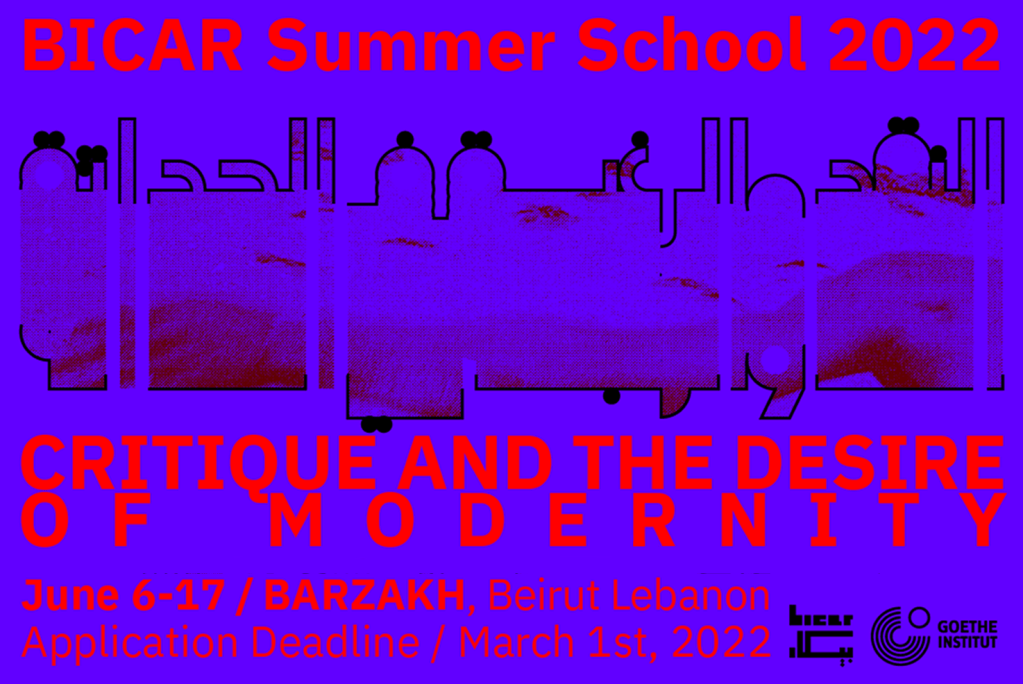
BICAR Summer School 2022

The Beirut Institute for Critical Analysis and Research (BICAR) will host its first summer school in Lebanon this June. The summer school is open to international and local students. It is intended as a pedagogical intervention at a catastrophic moment in Lebanon’s history. With economic collapse, severe shortages of fuel, electricity, and medicine, and over 80% of the Lebanese population living below the poverty line, the current capitalist crisis demands the development of adequate tools for understanding our historical present in ways that can also affect conditions of transformation. We at BICAR think that Lebanon is the future past of the failures of global neoliberalism, a place that can instruct us on the dismal future to come if the social, political, and economic contradictions of the present are left to their own historical trajectory. In order to concretely grasp the conditions of the present, we propose a patient return to the past and will be offering an intensive course program on classical and contemporary critical social theory and aesthetics. The school will consist of an introductory keynote lecture followed by four core courses offered over eight sessions.

Keynote Lecture

On the concept of prehistory, if it is one?
By Dr.  Frank Ruda

Capitalism seems to have changed everything. It established a fundamentally new form of organising social relations and from its conception nothing – and perhaps not even nothing – remained the same. These are assumptions that have been often attributed to Marx (and Marxists), even by Marxists. Yet Marx explicitly identified capitalist political economy as a prehistoric formation. This puts pressure on the concept of prehistory, if it is one. This talk will attempt to deal with this pressure by returning to Marx.

Dr. Frank Ruda is Senior Lecturer in Philosophy at the University of Dundee. He is the author of Abolishing Freedom: A Plea for a Contemporary Use of Fatalism (Nebraska University Press 2015); For Badiou: Idealism without Idealism (Northwestern University Press 2015) and Hegel’s Rabble: An Investigation into Hegel’s Philosophy of Right (Continuum 2011).

Course I

The Idea of Critical Theory
By Dr.  Ray Brassier

This course will track the development of the idea of critical theory from its original radical inception, focusing on its two fundamental components: the Marxian analysis of the commodity and the Freudian analysis of repression. We will conclude by considering the ‘critical pessimism’ to which critical theory’s founding figures, Max Horkheimer and Theodor Adorno, allegedly succumbed in their final years.

Dr. Ray Brassier is Professor of Philosophy at the American University of Beirut. He is the author of Nihil Unbound: Enlightenment and Extinction (Palgrave 2007).

Course II

On Negativity
By Dr.  Sami Khatib

This seminar explores negativity as concept, figure and affect. In Western thought, ‘negative’ thinking can be traced back to pessimism, skepticism, nihilism and dystopianism. For Hegel, however, negativity is the restless movement and dialectical driving force of cultural formation and education (Bildung). The seminar asks how global sites of class struggle and coloniality can be theorized as sites of negativity.

Dr. Sami Khatib is a substitute professor at the Karlsruhe University of Arts and Design (HfG). His publications include a co-editorship of the volume “Critique: The Stakes of Form” (Zürich, Berlin: Diaphanes, 2020) and authorship of the book “Teleologie ohne Endzweck: Walter Benjamins Ent-stellung des Messianischen” [“Teleology without End.” Walter Benjamin’s Dislocation of the Messianic], (Marburg: Tectum, 2013).

Course III

Marxist Aesthetics
By Dr.  Angela Harutyunyan, with Natasha Gasparian

While Marx and Engels never systematically wrote on aesthetics, throughout the twentieth century multiple attempts were made to construct systematic aesthetics based upon their writings. This course investigates such attempts both within Soviet Marxism and Western Marxism in the 1930s and 1960s as mirroring one another, albeit from different political systems and historical circumstances.

Dr. Angela Harutyunyan is Associate Professor of Art History and Theory and Head of the Art History Program at the American University of Beirut. She is editor of ARTMargins (MIT Press) and the author of The Political Aesthetics of the Armenian Avant-Garde: The Journey of the ‘Painterly Real,’ 1987–2004 (Manchester University Press 2017).

Natasha Gasparian is an art historian and curator who works on modern and
contemporary art in the Arabic-speaking world. She is the author of Commitment in the Artistic Practice of Aref El-Rayess: The Changing of Horses (Anthem Press, 2020). Currently, she is the curatorial assistant to Sam Bardaouil and Till Fellrath for the 16th edition of the Lyon Biennale.

Course IV

Anxiety and Authority: The Critical Use of Psychoanalysis
By Dr.  Nadia Bou Ali, with Mohamad Tal

Modernity is an age of neurosis, in which anxiety emerges as an affect linked to the demand for collective political solutions. If our present historical moment is characterized as an ‘age of anxiety’ overridden with depression, suicide, and paralysis, can we rethink anxiety without resorting to quick tranquilizing resolutions of the sort proposed by authoritarian figures like Trump, Orban, Bolsonaro, and Modi? The appeal of such figures invites us to reconsider the basis of what authority is and ought to be using psychoanalysis to diagnose its nature in relation to anxiety.

Dr. Nadia Bou Ali is Associate Professor and Chair of the Civilization Sequence Program at the American University of Beirut. She is the author of Hall of Mirrors: Psychoanalysis and the Love of Arabic (Edinburgh University Press 2020); and co-editor (with Rohit Goel) of Lacan contra Foucault: Subjectivity, Sex, and Politics (Bloomsbury Academic 2018).

Application and Deadline: 

CV/Resumé + 500 words statement of interest + 150 words statement about funding to be submitted by March 29, 2022

Contact: info@bicarlebanon.org
 

About BICAR

Established in 2015, the Beirut Institute for Critical Analysis and Research (BICAR) aims to promote critical thought and analysis with a special focus on studying manifestations of modernity in Lebanon and the Middle East. As a public research and educational institute, BICAR seeks to cultivate a space for rigorous research, debate, and dialogue. It intends to foster cultures of critique capable of understanding Lebanese modernity in relation to processes of modernization that are part of a global dynamic. BICAR has two fundamental commitments: to disseminate pedagogical and research oriented projects in Arabic and English to a wide audience in Beirut, Lebanon, and beyond; and to foster the relationship between intellectual inquiry, social reality, and social change. BICAR’s founding members are Dr. Nadia Bou Ali, Dr. Ray Brassier, Mr. Rohit Goel, Dr. Angela Harutyunyan, Dr. Sami Khatib, and Dr. Ghalya Saadawi.

Click here to mail your application to info@bicarlebanon.org

CfP: Historical Materialism Beirut

Historical Materialism Conference (HM) in Beirut from March 10 to March 12, 2017. BICAR is organizing this event in collaboration with the Center for Arts and Humanities (CAH) at the American University of Beirut (AUB); Jnanapravaha Mumbai (JP); and the Historical Materialism Journal in London.

Debates around historical materialism have evolved in the wake of the collapse of ‘actually existing’ socialist states, particularly since the fall of the Soviet Union, where historical materialism was the officially sanctioned method for understanding the dynamics of revolutionary reality. Socialist states in Latin America, the Middle East and North Africa, as well as South and South East Asia also claimed to follow historical materialism, whether officially or semi-officially, as part of the Cold War battle against the ideology of positivist neutrality. However different the outcomes of these historical attempts and experiments were, they prove the futility of turning states into an exclusive embodiment of historical materialism and treating the latter as an empty signifier serving the purposes of ideological state apparatuses. Post 1989, these contexts are no longer the historical embodiments of the method and historical materialism has been taken up and debated by the Left during the past three decades. Scholars around the world have attempted to rethink historical materialism in a post Cold War world where the end of history has been simultaneously proclaimed and perpetuated, both descriptively and normatively. Here we encounter a double fissure, the first triggered by the collapse of the very historical experiences that gave rise to historical materialism as a method, and the second by the schism between the realities of global capitalism today – the political status quo it generates – and the immanent imperative of the historical materialist method – the need to politicize theory despite the depoliticizing effects of capitalist ideology.

What happens when historical materialism, because of the historical conditions in which it is situated today, becomes a theoretical endeavor rather than a political weapon? Is it possible to reconnect method and practice, critique and practice, when the structural conditions – the untimely absence of a political avant-garde, mass mobilization movements with emancipatory agendas, and revolutionary political programs on a large scale – makes praxis difficult, even impossible?

This conference invites scholars, activists and other invested members of the public to think the possibility of praxis today by taking Beirut as both a critical site of the troubled legacies of communism, socialism and Stalinism, and as a site for critique. At the same time, Beirut is the dumping ground for neoliberal, authoritarian, and theocratic policies that date back to Lebanon’s role during the Cold War era. This ideological wasteland has a material base, articulated by the contradictions of global capitalism in today’s Lebanon: Beirut is the future past of the national state, a state without a state, run by sectarian neoliberalism. Despite this present, the short history of Beirut and Lebanon in the 20th century tells the untold story of what could have been: the unredeemed desire for a non-capitalist modernity, neither secular nor religious, neither “Western” nor “Eastern.”

Among the themes we would like to explore:

  • The False Promise of the Victim and the Desire for the Revolution
  • Primitive Accumulation
  • The Capitalist Unconscious: Lacan and Marx
  • Marxist and Materialist Feminism
  • Capitalism, Alienation, Authenticity
  • World History Without a Worldview
  • The Invisibility of the Class Struggle in the Aftermath of Colonialism
  • History and Repetition, or the Temporalities of Capitalism
  • Capitalism and Barbarism
  • What is Praxis?
  • Materialist Aesthetics
  • Deprovincializing Marxism

(This is a non-exclusive list – other subjects are of course welcome too. Pre-constituted panels are welcome but we reserve the right to disaggregate them and create new panels with some of the speakers proposed.)

The submissions (300 word abstracts) should be sent to info@bicar-lebanon.org, by August 15, 2016.