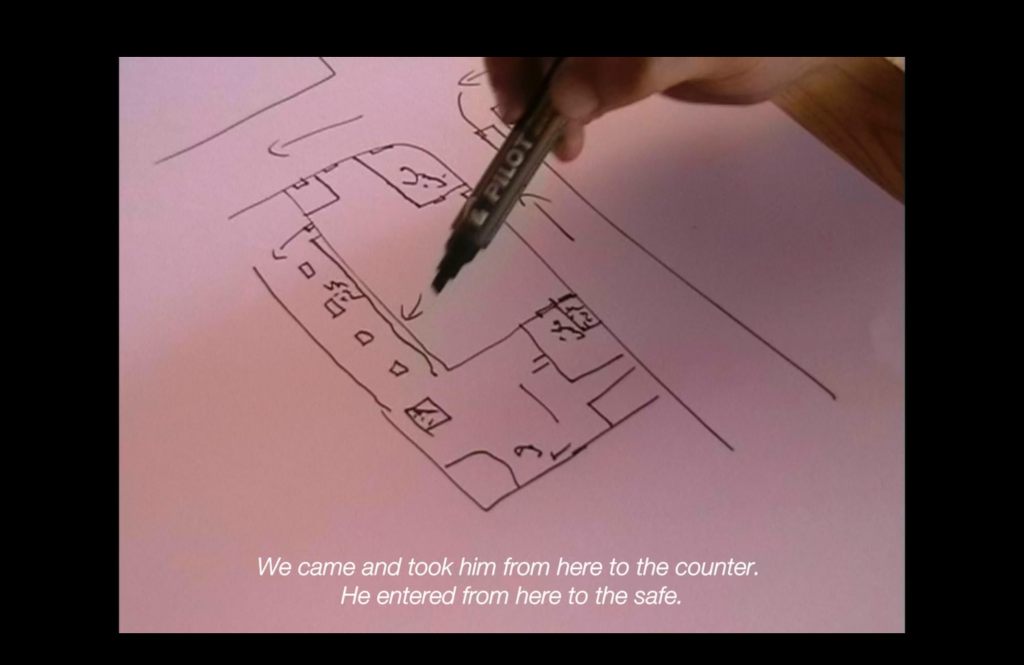
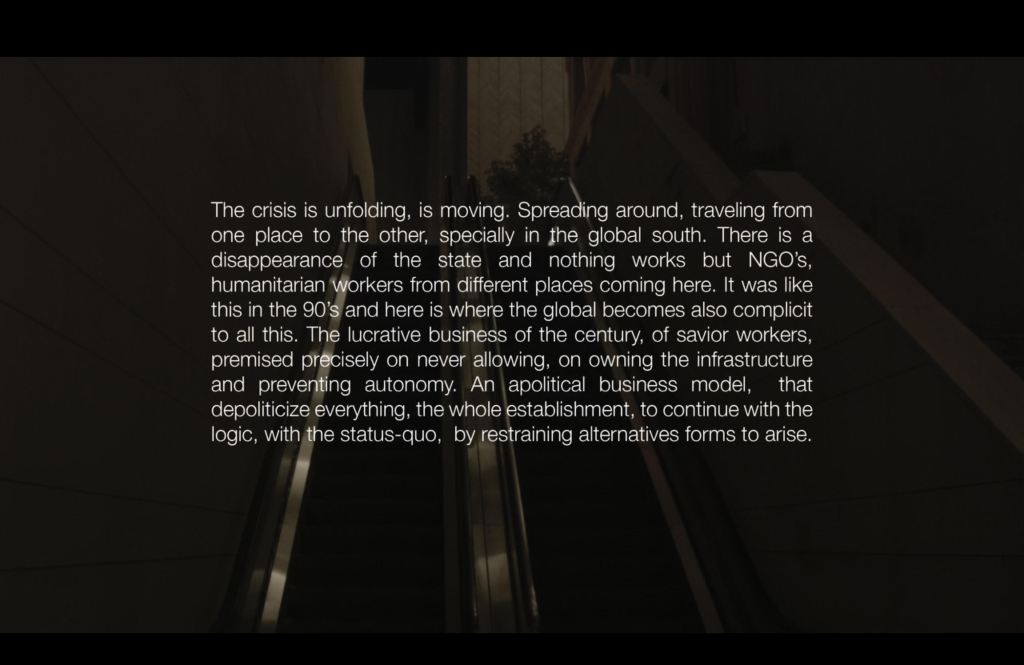
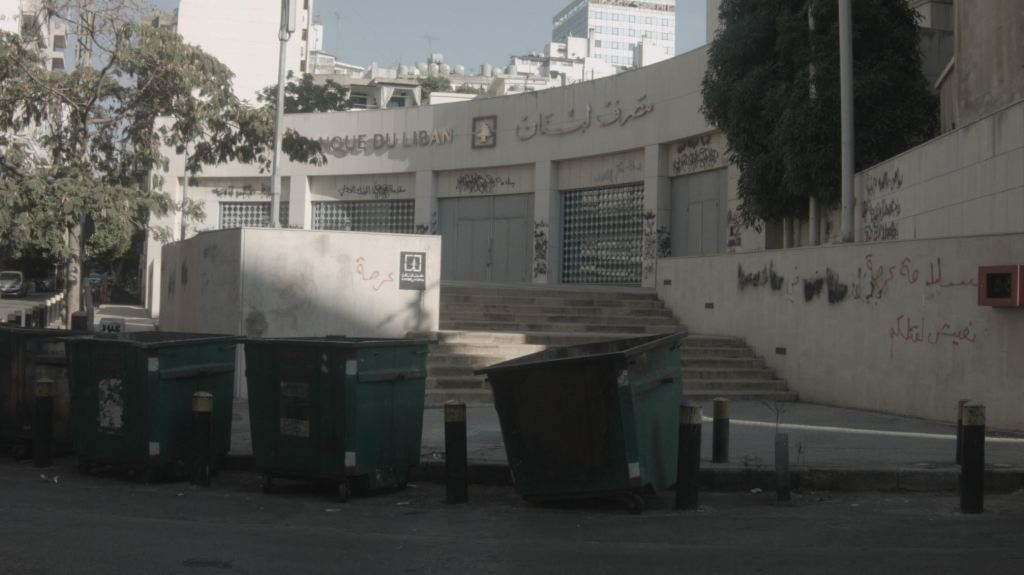
In 2022, the economic crisis in Lebanon had led the country to the brink of total collapse. By the time this film began was completed, more than 16 bank heists had been carried out across the country. Assembling interviews with depositors and the critical theorist Nadia Bou Ali along with archival images and TV material, On Bandits tries to make sense of the surreal situation in which the country finds itself.
Born in São Paulo, Brazil, Gian Gigi Spina is a writer, researcher, and sometimes an artist. He has worked and taught in pedagogical experiments, including International Art Academy Palestine, Escola da Cidade (São Paulo), the Ionion Center for Arts and Culture (Greece) as well as CILAS (Cairo). He is currently learning Arabic, while speaking five other languages, and is constructing an interdisciplinary body of work on the materialization of power in history, narrative and the public sphere. He was part of the residency programs as Capacete and Documenta 14 in Athens (2017), MMAG Foundation in Amman (2018) as well as GEGENWARTE/PRESENCES in Chemnitz, Germany (2020). Recently, he has participated in the Sheffield Film Festival, Les Rencontre d’Arles and the Museum of Modern Art in Rio de Janeiro. His writing has appeared in Mada Masr, Folha de São Paulo, Arts Everywhere, World Policy Institute, and several other independent publications. He lives Cairo and his work can be seen at http://gianspina.com
This event is organized by the Beirut Institute for Critical Analysis and Research (BICAR) for the 2023 Summer School, Is There a Revolutionary Subject? For more information, please visit https://bicarlebanon.org/summerschool/
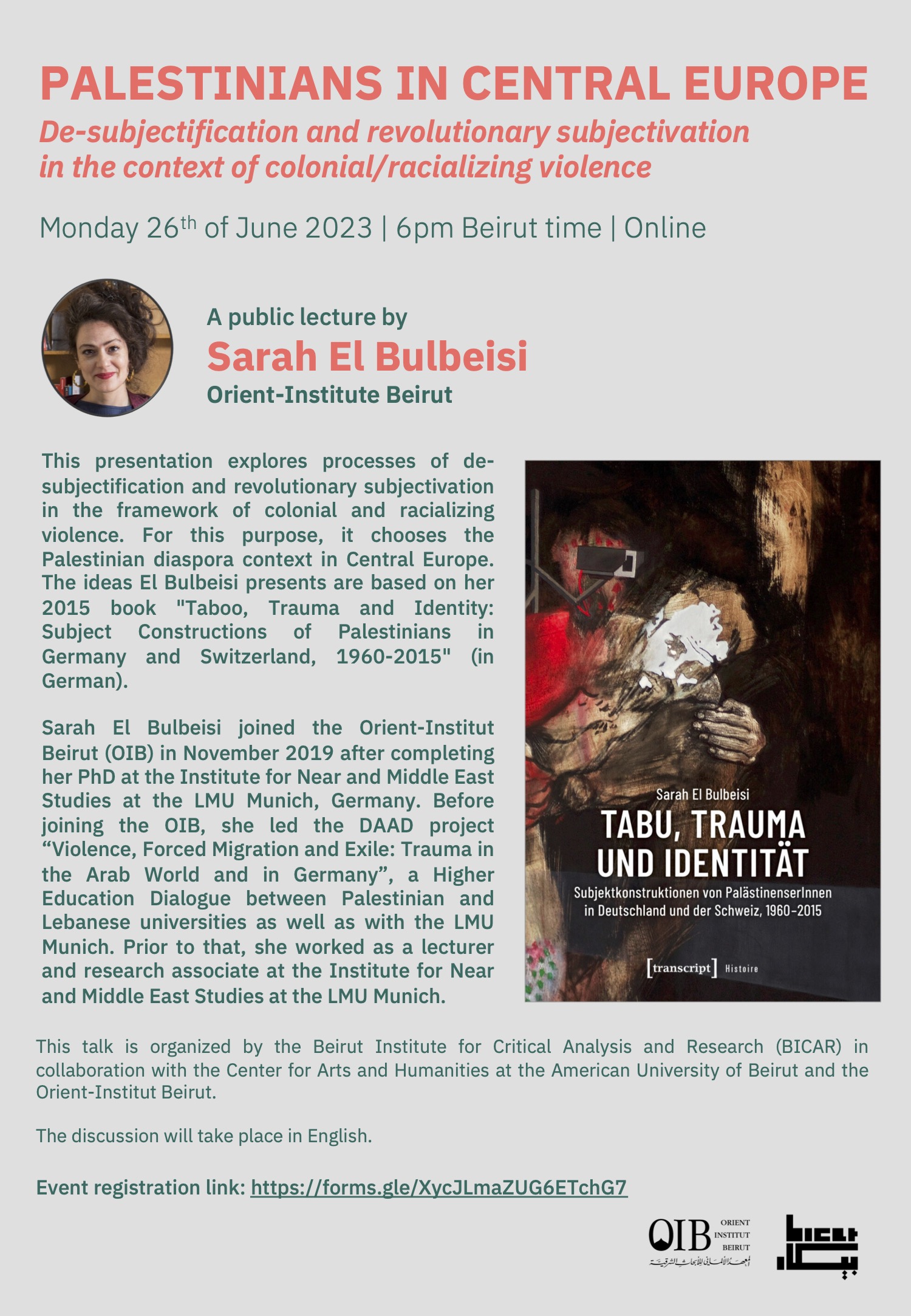
This presentation explores processes of de-subjectification and revolutionary subjectivation in the framework of colonial and racializing violence. For this purpose, it chooses the Palestinian diaspora context in Central Europe. The ideas El Bulbeisi presents are based on her 2015 book “Taboo, Trauma and Identity: Subject Constructions of Palestinians in Germany and Switzerland, 1960-2015” (in German).
Sarah El Bulbeisi joined the Orient-Institut Beirut (OIB) in November 2019 after completing her PhD at the Institute for Near and Middle East Studies at the LMU Munich, Germany. Before joining the OIB, she led the DAAD project “Violence, Forced Migration and Exile: Trauma in the Arab World and in Germany”, a Higher Education Dialogue between Palestinian and Lebanese universities as well as with the LMU Munich. Prior to that, she worked as a lecturer and research associate at the Institute for Near and Middle East Studies at the LMU Munich.
This talk is organized by the Beirut Institute for Critical Analysis and Research (BICAR) in collaboration with the Center for Arts and Humanities at the American University of Beirut and the Orient-Institut Beirut.
The discussion will take place in English.
الفلسطينيون في أوروبا الوسطى: نزع الخضوع وتشكّل الذات الثورية في سياق العنف الاستعماري / العنصري
يستكشف هذا العرض عمليات نزع الخضوع وتشكل الذات الثورية في إطار العنف الاستعماري والعنصري. لهذا الغرض اختير سياق الشتات الفلسطيني في أوروبا الوسطى. تستند الأفكار التي تقدمها سارة البلبيسي إلى كتابها الصادر عام 2015 بعنوان المحرم والصدمة والهوية: تركيبات الذات للفلسطينيين في ألمانيا وسويسرا، 1960-2015 (باللغة الألمانية)
انضمت سارة البلبيسي إلى المعهد الألماني للأبحاث الشرقية في نوفمبر 2019 بعد حصولها على درجة الدكتوراه في معهد دراسات الشرق الأدنى والأوسط في في ميونيخ، ألمانيا. قبل انضمامها إلى المعهد الألماني ، قادت مشروع العنف والهجرة القسرية والنفي: الصدمة في العالم العربي وفي ألمانيا، وهو حوار التعليم العالي بين الجامعات الفلسطينية واللبنانية وكذلك مع في ميونيخ. قبل ذلك، عملت كمحاضرة وباحثة مشاركة في معهد دراسات الشرق الأدنى والأوسط في ميونيخ
In collaboration with Beirut Art Center, we will be screening two films by Bahar Noorizadeh. The screenings will be followed by a discussion between the artist and Bassem Saad.
Friday June 23, 2023 | Beirut Art Center | 7pm To register for a place, please write intern@beirutartcenter.org
Teslaism: Economics After the End of the End of the Future (2023) Single-channel video (30’)
Installation view of Teslaism, Tresor 31 Exhibition, Kraftwerk Berlin, 2022, photo by Helge Mundt
Teslaism: Economics After the End of the End of the Future is a third-person racing musical game featuring Elon Musk and his self-driving car/lover and life coach as they drive towards a shareholder meeting in a post-gamified Berlin landscape.
The work takes the newly built Gigafactory in Berlin as a prism to describe the emergence of Teslaism (succeeding post-Fordism) as an upgrade to the system of production and consumption predicated on advanced storytelling, financial worldbuilding, and imagineering “the look of the future.” The Teslaist CEO is a collage artist. Weaving together one tweet, one dance move, one meme after another, he creates a set of perpetually postponed and too-fabulous-to-be-fake narratives to make time make power. If post-industrial Detroit was soundtracked to techno’s futures, the age of Teslaism seeks its own common sonic imaginaries: forms of resistance inhabiting our exceedingly financialized cities.
Teslaism was commissioned for Tresor 31: Techno, Berlin, and the Great Freedom (2022), an exhibition reflecting on three decades of musical evolution, social change, and city development from Berlin to Detroit, told through the lens of techno’s history.
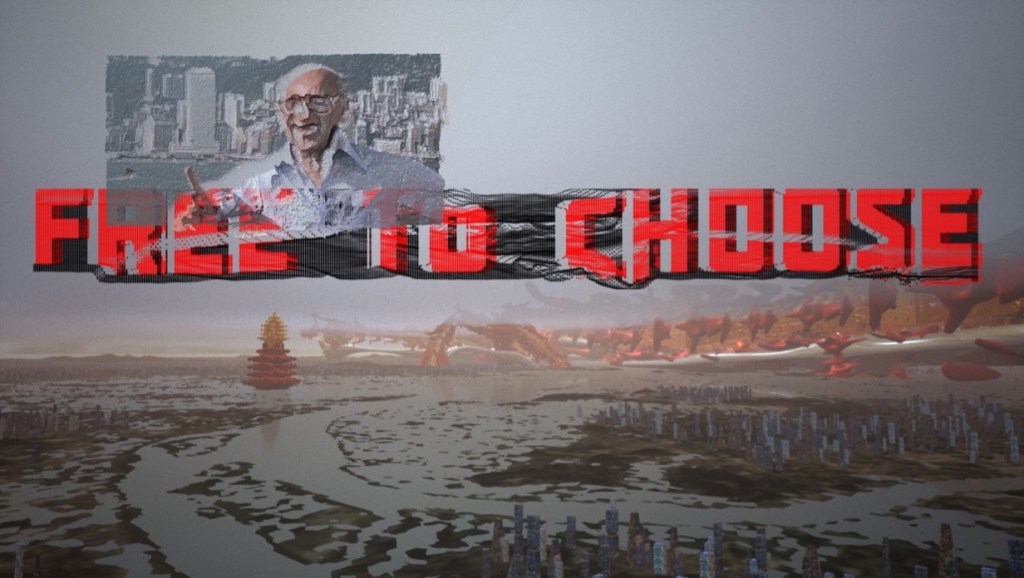
Free to Choose (2023) Single-channel video (36’), text Bahar Noorizadeh, Rudá Babau, and Waste Paper Opera
Still from Free to Choose (2023), courtesy of the artist.
Free to Choose is an operatic financial sci-fi (fi-fi), narrated by Milton Friedman, in which we encounter the credit banking system as a time travelling machine.
In 1997, in post economic crash Hong Kong, Philip Tose, ex-race car driver and CEO of an insolvent company travels to the future to borrow a lump sum from his older self to rescue his business. Hong Kong in 2047 turns out not to be very different from the Hong Kong of “One Country, Two systems”: centralisation has not eradicated nepotism, and activism has become rating activism: young people advocating for free time travel for everyone, including the untrustworthy and the discredited of a corrupt credit system.
In the background is superstar economist and real-life evangelist Milton Friedman’s myth of neoliberalism as represented by Hong Kong: In his long career as a market ideologue and advisor to the conservative governments of the US and the UK, Friedman hailed the city as the modern exemplar of free markets, needless of heavy-handed government planning and control. “If you want to see Capitalism in action, you should go to Hong Kong.”
Much like the economic worlds built in metaverse and gaming platforms today, Hong Kong was the testing ground for the parable of neoliberalism. Once certified in its advanced colony, neoliberalism would return to shape the economic policies of Western powers in the decades to come. In 2023, despite once claiming the highest rate of public housing in the world, Hong Kong now holds one of the deepest wealth gaps and one of the most lucrative real estate markets on the planet.
About the artist Bahar Noorizadeh looks at the relationship between art and capitalism. In her practice as an artist, writer and filmmaker, she examines the conflictual and contradictory notions of imagination and speculation as they suffuse one another. Her research investigates the histories of economics, cybernetic socialism, and activist strategies against the financialization of life and the living space, asking what redistributive historical justice looks like for the present. Noorizadeh is the founder of Weird Economies, a co-authored and socially-connected project that traces economic imaginaries extraordinary to financial arrangements of our time. She completed her PhD at Goldsmiths, University of London.
The discussion will take place in English.
This screening is organized by the Beirut Institute for Critical Analysis and Research (BICAR) in collaboration with Beirut Art Center for the 2023 Summer School, Is There a Revolutionary Subject?
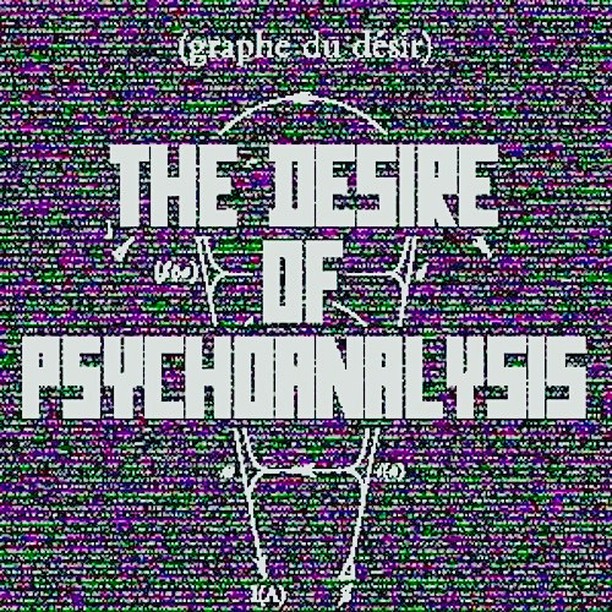
Joining the 2023 BICAR Summer School virtually, psychoanalysts Gabriel Tupinambá and Mohamed Tal will briefly introduce their recent books, the former’s The Desire of Psychoanalysis: Exercises in Lacanian Thinking (2021) and the latter’s The End of Analysis: Dialectics of Symbolic and Real before entering into a discussion with Nadia Bou Ali about the broader threads of the limits and challenges of psychoanalysis. What is the political import of psychoanalysis in a moment of rampant fantasies of the end (of the world)?
Mohamed Tal is a clinical psychologist and psychoanalyst. He had a private practice in Beirut from 2009 until 2022, when he moved to Dubai to practice. He is an affiliate of the Rome Institute and a member of the Beirut Institute for Critical Analysis and Research (BICAR). Dr Tal has worked as a psychotherapist with humanitarian organizations in the Middle East, including Doctors Without Borders, WarChild Holland, Handicap International, and Deutsche Gesellschaft für Internationale Zusammenarbeit. He also taught a seminar on “the Real” at the École Libanaise de Psychanalyse from 2018 to 2021.
Gabriel Tupinambá is a philosopher and psychoanalyst working from Rio de Janeiro. He is the Head of Social Strategy at the Alameda institute (www.alameda.institute) and a member of the research collective Subset for Theoretical Practice (www.theoreticalpractice.com). He is the author of The Desire of Psychoanalysis (NUP, 2021), and co-author of the book An Architecture of Edges: The Lefts in Times of World Peripheralization (Autonomia Literária, 2022) and Hegel, Lacan, Žižek (Altropos Press, 2013).
The discussion will take place in English
This event is organized by the Beirut Institute for Critical Analysis and Research (BICAR) for the 2023 Summer School, Is There a Revolutionary Subject? For more information, please visit https://bicarlebanon.org/summerschool/
Dziga Vertov’s documentary film Odinnadtsatyy (The Eleventh Year, 1928) is dedicated to the 11th year of the October Revolution. Joining other now canonical films that celebrate the first decade of the Bolshevik Revolution, such as Eisenstein’s October of the same year, Vertov’s film is a hymn to Stalin’s program of the rapid industrialization of the country, and especially the eastern regions of Ukraine.
The film both preludes and crystalizes the contradictions of Stalin’s so-called “second revolution”, otherwise known as the Great Turn, or the Great Break (Velikiy perelom) which launched a massive program of industrialization, and collectivization of agriculture. The film utilizes the techniques of avant-garde filming and montage to render cinematically the transformative power of socialist construction as constitutive of Soviet reality itself. The temporality of the film, as it moves from longer panning shots implying a narrative structure and historical meaning, to rapidly changing frames of nature-man-machine synthesis signifies the revolutionary and avant-gardist overcoming of the past for a future-directed present.
This screening is organized by the Beirut Institute for Critical Analysis and Research (BICAR) for Angela Harutyunyan’s course, “Time and Revolution: Historicity after “the End of History” within the 2023 Summer School, Is There a Revolutionary Subject?
دزيجا فيرتوف، السنة الحادية عشر، 1928 (54)
فيلم دزيجا فيرتوف الوثائقي (السنة الحادية عشرة، 1928) مخصص للسنة الحادية عشرة لثورة أكتوبر. إضافة إلى الأفلام المعتبرة الأخرى التي تحتفل بالعقد الأول من الثورة البلشفية، مثل فيلم أكتوبر لآيزنشتاين في العام نفسه، فيلم فيرتوف هو إشادة ببرنامج ستالين للتطور الصناعي السريع للبلاد، وخاصة المناطق الشرقية من أوكرانيا
يقدم الفيلم ويبلور تناقضات ما يسمى بـ”الثورة الثانية” لستالين، والمعروفة باسم “المنعطف الكبير” أو “الانهيار العظيم” (فيليكي بيرلوم) الذي أطلق برنامجًا ضخمًا للتطور الصناعي والتنظيم الجماعي للزراعة. يستخدم الفيلم تقنيات التصوير والمونتاج الطليعي ليظهر سينمائياً القوة التحويلية للبناء الاشتراكي كمكوِّن للواقع السوفيتي نفسه. إن زمنية للفيلم، حيث ينتقل من اللقطات الطويلة التي تنطوي على بنية سردية ومعنى تاريخي، إلى إطارات متغيرة بسرعة لتوليفة الطبيعة-الإنسان-الآلة، تدل على التغلب الثوري والطليعي على الماضي من أجل حاضر موجه نحو المستقبل.
تم تنظيم هذا العرض من قبل معهد بيروت للتحليل النقدي والبحوث (بيكار) لدورة أنجيلا هاروتيونيان، “الزمن والثورة: التاريخية بعد’ نهاية التاريخ‘” ضمن المدرسة الصيفية لعام 2023، هل يوجد ذات ثورية؟.
يسرّ بيكار، معهد بيروت للتحليل النقدي والبحوث، أن يدعو المنظِّمات/ين السياسيات/ين، العمال، والطلبة للمشاركة بالاستبحار في خيالنا السياسي الجمعي من خلال حوار مفتوح حول التنظيم النضالي، مآزق التحرر السياسي، وأزمات اليسار. سنستضيف المتحدث غابريال توبينامبا الذي سيتناول الأزمات التي يتخبط بها اليسار البرازيلي والمشاكل الذاتية مع التنظيم السياسي
ستحدث المناقشة يوم السادس من أيار/مايو، عند الساعة الخامسة مساءً في مانشن بيروت، زقاق البلاط
غابريال توبينامبا فيلسوف ومحلل نفسي يعمل من ريو دي جانيرو. يشغل منصب رئيس الاستراتيجية الاجتماعية في معهد ألاميدا، كما أنه عضو في المجموعة البحثية فرع الممارسة النظرية. صدر له ”رغبة التحليل النفسي“، و ”هيغل، لاكان، جيجك“، كما شارك في كتابة: عمارة الحواف: اليُسُر في أزمنة التطريف
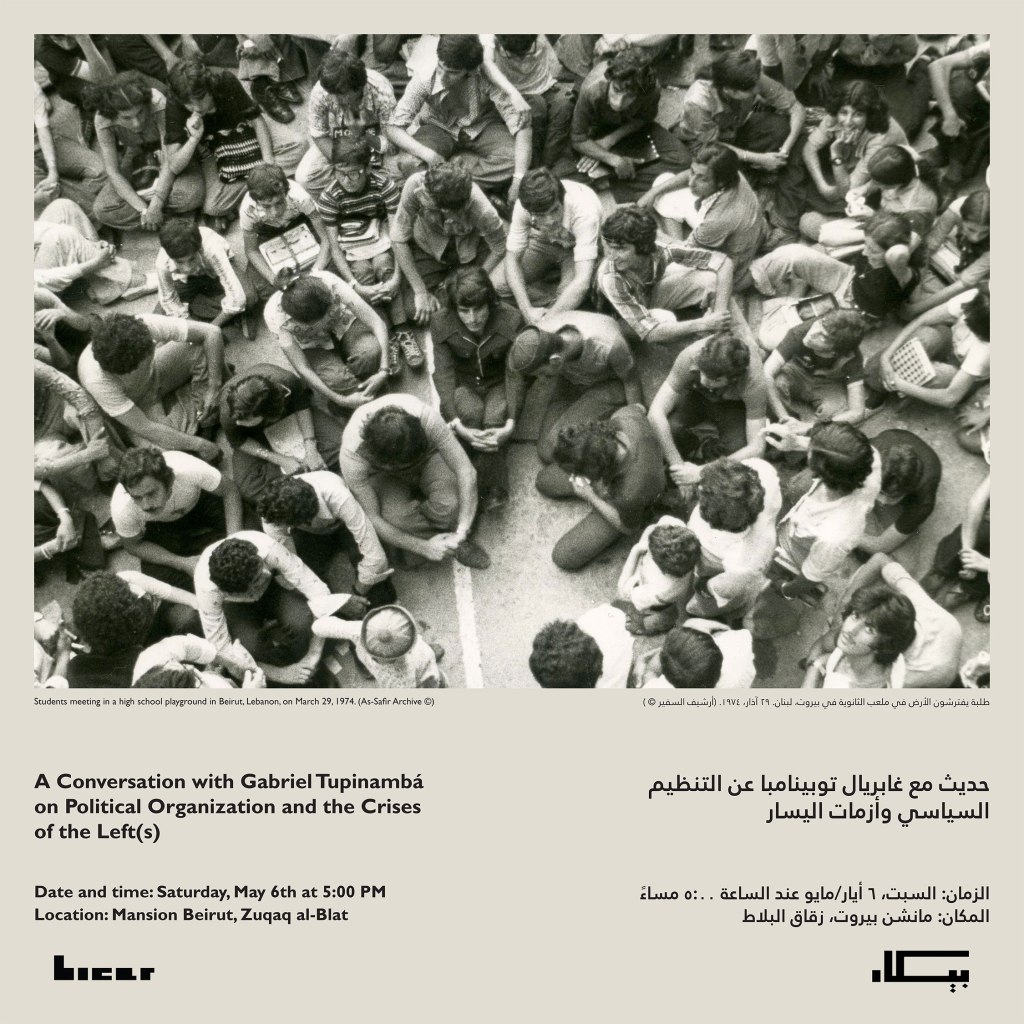
Beirut Institute for Critical Analysis and Research (BICAR) is delighted to invite leftist organizers, workers and students to participate in expanding our collective political imagination through an open dialogue around the question of militant organization, impasses of political emancipation and the crises of the left(s). As our guest speaker, Gabriel Tupinambá will address the crises of the Brazilian left and the subjective problems that arise in political organization.
The discussion will take place on May 6th at 5:00 PM in Mansion Beirut, Zuqaq Al-Blat.
Gabriel Tupinambá is a philosopher and psychoanalyst working from Rio de Janeiro. He is the Head of Social Strategy at the Alameda institute (www.alameda.institute) and a member of the research collective Subset for Theoretical Practice (www.theoreticalpractice.com). He is the author of The Desire of Psychoanalysis (NUP, 2021), and co-author of the book An Architecture of Edges: The Lefts in Times of World Peripheralization (Autonomia Literária, 2022) and Hegel, Lacan, Žižek (Altropos Press, 2013).
Beirut Institute for Critical Analysis and Research Summer School June 2023 June 19-30, Beirut Is There a Revolutionary Subject?
Is the absence of revolution due to the absence of a revolutionary subject? Or to the belief that revolution requires a subject? The critique of the subject–Cartesian, Kantian, Hegelian– is the cornerstone of the Nietzschean and Heideggerian critiques of modernity (and of their reactionary politics). It was subsequently given an emancipatory cast not only by Nietzschean thinkers such as Derrida, Foucault, and Deleuze but also by Marxists like Adorno, for whom the primacy of the subject forms the crux of the logic of domination. From this vantage, Lukacs’ theory of the revolutionary subject, which centers the proletariat as self-conscious commodity, is supposedly tainted not just by residual Hegelianism but by a logic of domination culminating in Stalinism. Yet perhaps the time has come to re-appraise Lukacs’ theory, given that no alternative of comparable power has come to replace it.
Psychoanalysis, for its part, develops a more nuanced critique of the subject. Where poststructuralism reduces the subject to an effect of impersonal forces–substantializing the unconscious–psychoanalysis conceives it as an irreparable tear in the fabric of being. The subject is the gap manifesting the unconscious as ‘not-fully-being’. In this regard, psychoanalysis renovates the Hegelian concept of the subject as self-relating negativity. Subjective destitution, as conceived by Lacan, is only possible via the discourse of psychoanalysis, which paves the way for a transformative act. But the destitution of the subject in contemporary critical discourse continues to be conceived in poststructuralist terms. This destitution marks the shift from the conception of revolution as total explosion to the claim that what is revolutionary is the explosion (or implosion) of totality. Disintegration and fragmentation become the new indices of social subversion. The political valence of this shift has been much debated: subversion of liberalism or liberal subversion? Both remain politically equivocal: the disintegration of totality is affirmed by fascist reactionaries as well as utopian anarchists.
History also seems to confirm the destitution of the revolutionary subject. The European working class’s post-war accommodation with capitalism (not to mention its embrace of fascism in the 1930s) casts doubt on attempts to invest it with revolutionary agency. In the fifty years since the end of the post-war boom (1973), capital’s renewed onslaught against labor has not reconsolidated the working class into a revolutionary subject. Thus communists have reaffirmed the distinction between proletariat and working class to challenge the latter’s revolutionary credentials together with the assumption that revolution requires a unitary subject. This includes not only Althusserians, for whom history is a process without a subject, but also those who propose that self-negation, rather than self-affirmation, is the motor of proletarian struggle against capital. In a related but distinct vein, Alain Badiou makes the theory of the subject central to communism while decoupling revolutionary subjectivation from the appropriation of production. Lastly, Adorno’s critique of the principle of subjectivity seeks to preserve the singularity of individual experience as a site of resistance to capitalist totality. The question is whether such singularity can be encompassed by class struggle and reconnected to collective solidarity. In all these instances, the concepts of capital, labor, totality, revolution, and subject are variously articulated with very different political consequences.
Moreover, how do the objective and subjective dimensions of race, gender, and sexuality connect with those of class? If proletarianization is an ongoing process that consists of homogenizing and commodifying subjective experience, what are the concrete mechanisms through which it occurs? The list might include capitalist ecologies, the privatization and individualization of symptoms by the therapy and wellness industries, as well as the ongoing co-optation of all potential sites of radical enunciation by the discourses of neo-liberal capitalism. How might a revolutionary subject withstand this slow emptying out of social experience? Can it be sustained against such mechanisms? What kind of militancy is required and what can psychoanalysis actually offer to militant subjects in this regard? Can psychoanalysis help resist this process of psychic hollowing? Could it help reconstruct a theory of the revolutionary subject?
This summer school will investigate the different registers and political valences of the critique of the subject and try to gauge its consequences for the understanding of revolution. Is the destitution of the subject revolutionary? Or does it ultimately dissolve revolution as idea and political practice?
Course I – Dr. Nadia Bou Ali Subjective Destitution
Psychoanalysis has one main promise for politics and it is surely not a joyful one: the experience of subjective destitution is one possible way to counter the generalized systemic enjoyment that prevails in late capitalism. What is subjective destitution really? How can it be explained if it is not experienced? The seminar will discuss this in the context of Lacan’s theory of four discourses (Seminar XVII) and ask is the discourse of the analyst a discourse of subjective destitution? If so, what is the actual use of this politically?
Dr. Nadia Bou Ali is Associate Professor and Chair of the Civilization Sequence Program at the American University of Beirut. She is the author of Hall of Mirrors: Psychoanalysis and the Love of Arabic (Edinburgh University Press 2020).
Course II – Dr. Ray Brassier Theories of the Communist Subject
This course will consider whether the critique of Marxist programmatism and the perspective of communisation developed by Theorie Communiste (TC) dissolves or renews the question of the revolutionary subject. We will examine the theoretical presuppositions and political implications of the fundamental question guiding all of TC’s analyses, namely: “How can the proletariat, acting strictly as a class, be the class that abolishes class?” We will compare TC’s analysis to that of theorists who offer positive accounts of the communist subject, such as Lukacs and Badiou, as well as to theorists who consign the category of the subject to capital, such as Postone.
Dr. Ray Brassier is Professor of Philosophy at the American University of Beirut. He is the author of Nihil Unbound: Enlightenment and Extinction (Palgrave 2007).
Course III – Dr. Sami Khatib The Specter of Universalism: Concepts, Politics, Ideologies
This course starts from Vivek Chibber’s insight that in global capitalism at least two universalisms are at work: (1) the “universalizing drive of capital,” which stands against (2) the “universal interest of the subaltern classes to defend their wellbeing against capital’s domination” (Chibber, 2013). Against culturalist framings of universalism as a trope and idea limited to “western” Enlightenment thought, this course explores conceptual and political legacies of universalisms ‘from below’. Against conventional logic, universalism is not the (oppressive) flipside of particularism. As certain strands of anticolonial Marxism have shown, a dialectical-materialist concept of universality cannot rely on a choice between pre-established opposites. Rather, universality as dialectical concept and universalism as emancipatory politics call for a third term, be it a political subject, an absent cause, a lack, a surplus, a remainder, a singular embodiment, irreducible to abstract particularities and their culturalist, liberal or fascist ideologies.
Dr. Sami Khatib is a substitute professor at the Karlsruhe University of Arts and Design (HfG). His publications include a co-editorship of the volume “Critique: The Stakes of Form” (Zürich, Berlin: Diaphanes, 2020) and authorship of the book “Teleologie ohne Endzweck: Walter Benjamins Ent-stellung des Messianischen” [“Teleology without End.” Walter Benjamin’s Dislocation of the Messianic], (Marburg: Tectum, 2013).
Course IV – Dr. Ghalya Saadawi The Founding Violence of Law and Liberal Legalism’s Plea for the Law
The founding violence of Law is covered over as the law. Law is split. This seminar will begin drawing out relations between founding repression (Freud, Marcuse etc.) and the founding violence of the Law (Žižek, Lacan, Dean etc.) to subsequently consider, from a contemporary perspective, the appeals of what some have broadly called liberal legalism (to law, to rights, to standpoint, to human rights, to identity, and so on). This legalism seems to sideline immanent or left critique (including that of critical legal theory), represses liberation from the law that constructs its claims, and misreads the law (and superego)’s injunctions to both obey and enjoy. We try to read this alongside the once historical contention that liberating the drives was sufficient for liberation itself, misunderstanding the drives’ doubleness as both instinct and congealed forms of the social. Falling into the fiction of Law’s founding violence, and misreading itself as split, legalism thereby cannot consider the historical conditions of its emergence and splitness, and thus an emancipatory horizon beyond it. Is liberal legalism that antinomic to the work of critique? The seminar begins to explore the contradictions of founding violence and demand for the law, with the question of critique and emancipation.
Dr. Ghalya Saadawi is senior lecturer at the Centre for Research Architecture in the Department of Visual Cultures at Goldsmiths University of London, and theory tutor at the Dutch Art Institute, ArtEZ University. Recent articles include “Critical Incision: Hypochondria, Autotheory, and the Health-Illness Dialectic” in PhiloSOPHIA (2022), and “Vapid Virtues, Real Stakes: Diagnosis for Left Art Protocols” in Between the Material and the Possible Infrastructural Re-examination and Speculation in Art, edited by Bassam El Baroni (2022).
Course V – Dr. Angela Harutyunyan Time and Revolution: Historicity after “the End of History”
The course investigates the historical and conceptual conditions of possibility for a temporality hegemonic in our contemporary times, namely presentism. As a quality of historical time presentism is marked by the omnipresence of the present, without a sense of a historical past, or futurity. The course diagnoses this ideologically inflicted condition as constituted in the wake of the failure of twentieth-century revolutionary projects. It moves from the neoliberal present where time stands still in the order of deadlines, fiscal “futures,” exploitation of nature and the looming planetary ecological catastrophe, to the historical experiences of revolutionary transformations and their theorization in critical theory. We will read selections from Fred Jameson’s Valences of the Dialectic (2000), Francois Hartog’s Regimes of Historicity: Presentism and the Experience of Time (2003), Henri Lefevre’s Dialectical Materialism (1938) and Maurice Merleau-Ponty’s Humanism and Terror (1947), amongst other texts.
Dr. Angela Harutyunyan is Associate Professor of Art History and Theory at the American University of Beirut. She is editor of ARTMargins (MIT Press) and the author of The Political Aesthetics of the Armenian Avant-Garde: The Journey of the ‘Painterly Real,’ 1987–2004 (Manchester University Press 2017). She has co-founded the Johannissyan Institute for Research in the Humanities in Yerevan and BICAR in Beirut. Her book After Revolution:Historical Presentism and the Political Eclipse of Postmodernity co-authored with Eric Goodfield is forthcoming with Leuven University Press.
Application and Deadline:
CV/Resumé + 500 words statement of interest + 150 words statement about funding to be submitted by March 15, 2023
Established in 2015, the Beirut Institute for Critical Analysis and Research (BICAR) aims to promote critical thought and analysis with a special focus on studying manifestations of modernity in Lebanon and the Middle East. As a public research and educational institute, BICAR seeks to cultivate a space for rigorous research, debate, and dialogue. It intends to foster cultures of critique capable of understanding Lebanese modernity in relation to processes of modernization that are part of a global dynamic. BICAR has two fundamental commitments: to disseminate pedagogical and research oriented projects in Arabic and English to a wide audience in Beirut, Lebanon, and beyond; and to foster the relationship between intellectual inquiry, social reality, and social change. BICAR’s founding members are Dr. Nadia Bou Ali, Dr. Ray Brassier, Mr. Rohit Goel, Dr. Angela Harutyunyan, Dr. Sami Khatib, and Dr. Ghalya Saadawi.
Talking Hands / говорящие руки, 2016, 48 min, HD (and 16mm transferred to HD). Dir. Emanuel Almborg
Talking Hands / говорящие руки, is a film about the 1960s Zagorsk school for deaf-blind children outside Moscow and its pedagogy. The school was established by Marxist philosopher Eval’d llyenkov, who, in contention with dominant Soviet ideology, began developing ideas of how human consciousness is socially constituted and emerges in relation to material culture, objects, and tools.
The screening will be followed by a discussion.
This event is organized by the Beirut Institute for Critical Analysis and Research (BICAR) for the 2022 Summer School, Critique and the Desire of Modernity. For more information, please visit https://bicarlebanon.org/summerschool/
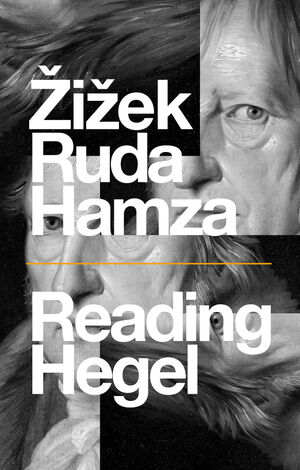
Frank Ruda, one of the volume’s editors, is launching Reading Hegel (Polity Books) in the presence of. This event will be held in English and is open to the public.
A spirit is haunting contemporary thought – the spirit of Hegel. All the powers of academia have entered into a holy alliance to exorcize this spirit: Vitalists and Eschatologists, Transcendental Pragmatists and Speculative Realists, Historical Materialists and even ‘liberal Hegelians’.
Which of these groups has not been denounced as metaphysically Hegelian by its opponents? And which has not hurled back the branding reproach of Hegelian metaphysics in its turn? Progressives, liberals and reactionaries alike receive this condemnation.
In light of this situation, it is high time that true Hegelians should openly admit their allegiance and, without obfuscation, express the importance and validity of Hegelianism to the contemporary intellectual scene.
To this end, a small group of Hegelians of different nationalities have assembled to sketch the following book – a book which addresses a number of pressing issues that a contemporary reading of Hegel allows a new perspective on: our relation to the future, our relation to nature and our relation to the absolute.
Dr. Frank Ruda is Senior Lecturer in Philosophy at the University of Dundee. He is the author of Abolishing Freedom: A Plea for a Contemporary Use of Fatalism (Nebraska University Press 2015); For Badiou: Idealism without Idealism (Northwestern University Press 2015) and Hegel’s Rabble: An Investigation into Hegel’s Philosophy of Right (Continuum 2011).
This event is organized by the Beirut Institute for Critical Analysis and Research (BICAR) for the 2022 Summer School, Critique and the Desire of Modernity. For more information, please visit https://bicarlebanon.org/summerschool/
Capitalism seems to have changed everything. It established a fundamentally new form of organising social relations and from its conception nothing – and perhaps not even nothing – remained the same. These are assumptions that have been often attributed to Marx (and Marxists), even by Marxists. Yet Marx explicitly identified capitalist political economy as a prehistoric formation. This puts pressure on the concept of prehistory, if it is one. This talk will attempt to deal with this pressure by returning to Marx.
Dr. Frank Ruda is Senior Lecturer in Philosophy at the University of Dundee. He is the author of Abolishing Freedom: A Plea for a Contemporary Use of Fatalism (Nebraska University Press 2015); For Badiou: Idealism without Idealism (Northwestern University Press 2015) and Hegel’s Rabble: An Investigation into Hegel’s Philosophy of Right (Continuum 2011).
This event is organized by the Beirut Institute for Critical Analysis and Research (BICAR) for the 2022 Summer School, Critique and the Desire of Modernity. For more information, please visit https://bicarlebanon.org/summerschool/



 Beirut Institute for Critical Analysis and Research